How to Choose a HEPA Air Purifier for Bedrooms, Nurseries, and Apartments
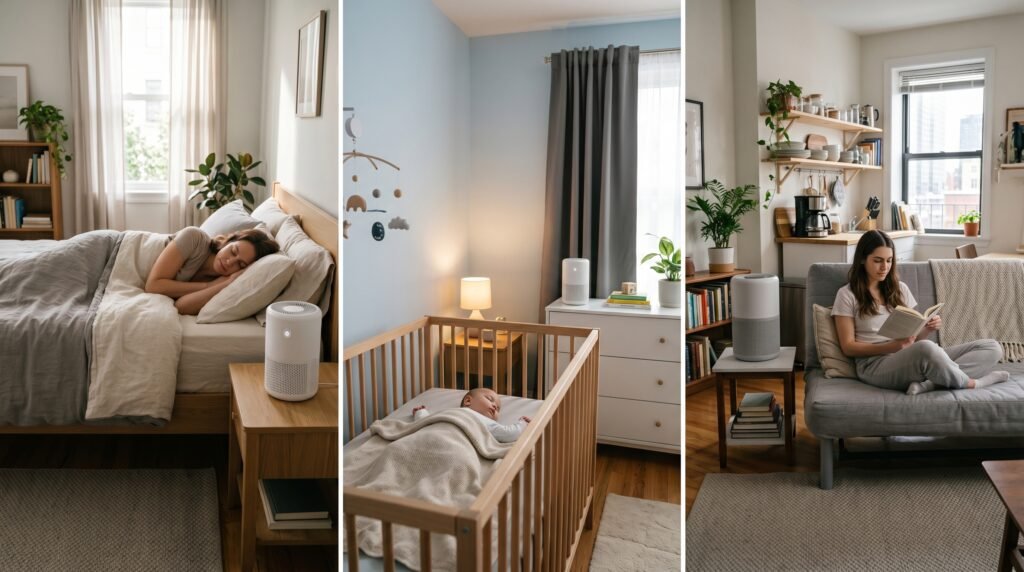
Bedrooms, nurseries, and small apartments are the spaces where people spend the most time, but they are also the spaces where dust, pollen, pet dander, fabric particles, cooking residue, and everyday indoor pollutants can linger the longest. A portable air purifier can help reduce some of that particle load, but it is not a magic fix for every indoor air problem. The U.S. Environmental Protection Agency (EPA) says the best approach is still to control pollution at the source, bring in clean outdoor air when possible, and use air cleaning as an added layer of help. Portable units are mainly meant for a single room or a specific area, not whole-house purification.
Many people buy an air purifier based on marketing instead of buying based on the type of pollution, the real room size, and the way the machine will actually be used. That usually leads to one of three mistakes: buying a purifier that is too weak for the space, buying one that is too loud to run overnight, or paying extra for flashy technologies that do not solve the main problem.
Quick answer before we go deeper
If you only remember five things, remember these:
| What you are trying to solve | What to prioritize |
|---|---|
| Dust, pollen, pet dander, airborne particles | A purifier with a real HEPA filter |
| Odors, cooking smells, some gases | A purifier with activated carbon, not HEPA alone |
| Bedrooms, nurseries, apartments | Start with room size and CADR, not marketing claims |
| Concerns about ozone or “ion” features | Avoid ozone-generating claims and check CARB-certified listings |
| Light sleepers or baby rooms | Look closely at noise levels, especially at useful fan speeds |
That framework comes directly from EPA guidance on HEPA, room sizing, CADR, and ozone-related air cleaning devices, plus CARB’s certification program and ENERGY STAR’s reporting requirements for air cleaners.
What a HEPA air purifier actually does
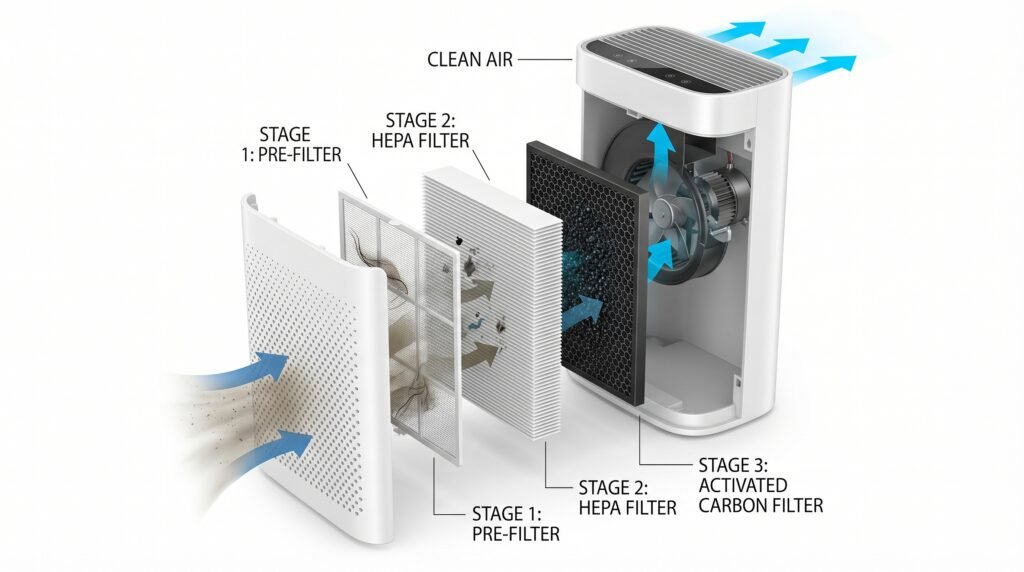
HEPA stands for High Efficiency Particulate Air. EPA explains that HEPA filtration is designed to capture at least 99.97% of particles at 0.3 microns, which is the “most penetrating” particle size used in the standard. In practical home use, that makes HEPA especially useful for airborne particles such as dust, pollen, mold spores, pet dander, and other fine irritants.
But this is where many air purifier articles become misleading: HEPA is mainly about particles, not gases. If your main complaint is cooking smell, pet odor, or general stale-air odor, a HEPA filter alone is not the full answer. EPA notes that gases and odors are a different problem and usually require activated carbon or another sorbent material.
In simple terms:
HEPA is for particles. Carbon is for odors and some gases.
Confusing those two jobs is one of the easiest ways to buy the wrong machine.
Why bedrooms, nurseries, and apartments should not be treated the same
Bedrooms: enough airflow, but quiet enough to live with
An air purifier only helps if you actually keep it running. EPA notes that the more air moves through the filter, the more cleaning you get, but lower fan speeds also mean lower cleaning performance. That matters in bedrooms because a purifier that is “strong enough on paper” may still be too loud on its most effective setting, which pushes people to lower the fan speed or stop using it overnight.
For a bedroom, the best balance is usually:
- the right room coverage,
- a solid CADR,
- acceptable overnight noise,
- and ideally a sleep mode or display-off option.
Nurseries: safety and simplicity matter more than flashy technology
For a nursery, the safest approach is not to chase every premium-sounding feature. EPA warns that some ionizers and other electronic air-cleaning technologies can create ozone or reactive byproducts, and CARB specifically maintains a list of certified air cleaning devices to help filter out unsafe ozone-emitting products. CARB also warns that ozone generators should not be used in occupied spaces.
For a nursery, the priority list is usually:
- HEPA for particles,
- no ozone-generating claims,
- low noise,
- simple controls,
- and easy filter replacement.
Apartments: size the purifier for the real space, not the label in your head
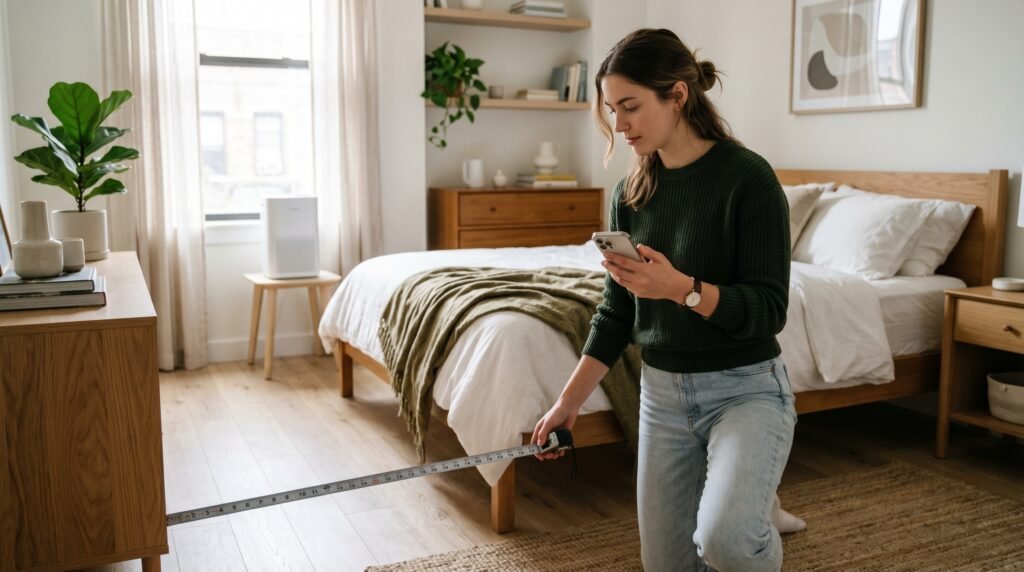
EPA says portable air cleaners are intended for a room or specific area, not for an entire house. That becomes especially important in studio apartments or open-plan layouts. If your bed, sofa, desk, and kitchen all share the same air volume, you cannot size the purifier as if it only serves a small bedroom corner. You need to size it for the real area you expect it to clean, and EPA also notes that higher ceilings can require a larger-capacity unit.
Start with room size and CADR, not marketing claims
This is the most important part of the buying decision.
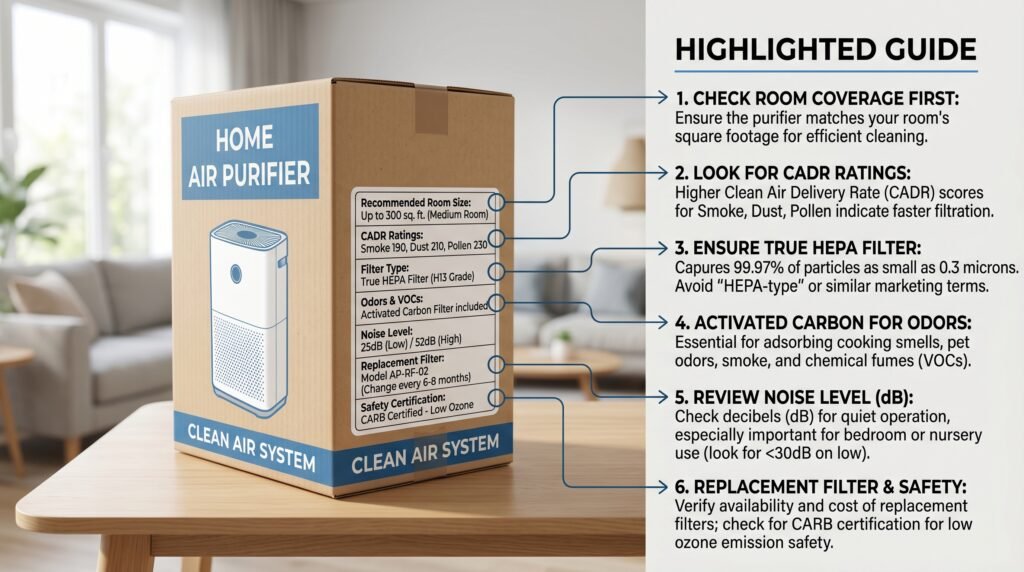
CADR means Clean Air Delivery Rate. EPA explains that CADR shows how quickly a purifier can deliver cleaned air, and that a higher CADR means the unit can clean particles faster and serve a larger space. Packaging may also list three CADRs separately for smoke, dust, and pollen, which represent different particle sizes. If you are buying for bedrooms, nurseries, or apartments and want better fine-particle performance, the smoke CADR is especially useful because it represents the smallest tested particles of the three.
EPA recommends choosing a purifier with a CADR large enough for the room or area where it will be used. They also note that if your home has an open floor plan or ceilings above the standard height, you should consider sizing up. The practical takeaway is simple: do not start with the prettiest machine, the highest star rating, or the loudest marketing terms. Start with the actual square footage and the real airflow performance.
Smoke, dust, and pollen CADR are not the same thing
Some air purifiers list one broad room coverage number, while others list separate CADR values for smoke, dust, and pollen. EPA explains that those test categories represent different particle sizes, and the smoke value is the most useful one when you care about very fine airborne particles. That is why two purifiers that claim similar “maximum coverage” can still feel different in real use. A model with a better smoke CADR will usually make more sense for bedrooms and everyday particle control.
This is also why “covers up to 1,000 square feet” is often less helpful than it looks. Coverage claims can depend on how many air changes per hour the brand is assuming, while CADR gives you a more grounded performance metric.
HEPA vs. carbon: know what problem you are really solving
A lot of shoppers say they want “cleaner air,” but that can mean very different things.
If you are dealing with:
- dust,
- pollen,
- pet dander,
- airborne particles from fabrics or daily activity,
then HEPA is the first thing to prioritize.
If you are dealing with:
- cooking smells,
- litter box odor,
- pet odor,
- smoke odor,
- general stale-air odor,
then you should look for a purifier that includes activated carbon or another sorbent material. EPA notes that CADR is for particles, not gases, and there is no equally familiar universal rating system for gas-removal performance in portable air cleaners. That means carbon-filter quality and filter replacement cost matter more than many shoppers realize.
Ionizers, ozone, plasma, and UV: do not let buzzwords distract you
If your real goal is cleaner air in a bedroom, nursery, or apartment, a good fan-and-filter purifier is usually the most understandable starting point.
EPA explains that some ion generators charge particles so they stick to surfaces, and in some cases those particles can be re-released back into the air later. EPA also warns that ozone is a lung irritant, and that some air cleaning technologies can generate ozone directly or indirectly. CARB maintains a certification list for air cleaning devices and separately warns against ozone generators marketed as air purifiers in occupied spaces.
That does not mean every non-HEPA feature is automatically useless. It means you should not let “plasma,” “active oxygen,” “super ion,” or similar language distract you from the basics that matter most:
- real room size,
- real CADR,
- real filter type,
- and real replacement cost.
A purifier will not fix a moisture problem or a mold source
This is one of the most important trust-building points to keep in the article.
EPA says air cleaners can help remove some airborne particles, but they are not a substitute for fixing the underlying source of indoor pollution. If a home has a moisture issue or mold growth, the moisture problem still needs to be corrected. An air purifier may reduce some airborne particles, but it does not solve the root cause.
That matters because many readers shopping for air purifiers are really trying to solve a humidity, condensation, or mold problem. In those cases, the better long-term answer may involve moisture control, better ventilation, or a dehumidifier rather than expecting a purifier to do everything.
Features that are actually worth paying for
Once you have the basics right, features can make a difference.
The most useful ones are usually:
- sleep mode
- display-off mode
- auto mode
- child lock
- easy filter replacement
- and clear replacement filter information
ENERGY STAR’s room air cleaner criteria specifically require reporting the filter type shipped with the product and the replacement filter model number, which is a strong reminder that filter maintenance is not a minor detail. It is part of the real ownership cost.
Placement matters more than many people think
EPA recommends putting a portable air cleaner in the room where you spend the most time and making sure airflow is not blocked. In practice, that means you do not want the purifier crammed behind furniture, buried in a corner with restricted intake, or placed where curtains and soft furnishings choke airflow.
A simple rule works well:
- in a bedroom, place it near the sleeping area but not blasting directly into your face,
- in a nursery, keep it stable and safely out of reach,
- in an apartment, place it where it can serve the zone you actually live in most.
Recommended models to consider
These are not the only good air purifiers on the market, but they make useful real-world reference points for readers who want something concrete to compare after learning the basics.
Levoit Core 300S
A strong reference choice for small bedrooms. Levoit lists it at 141 CFM CADR, 22–50 dB noise, and 219 sq ft at 4.8 air changes per hour, which makes it easy for shoppers to understand whether it is sized for a typical bedroom.
Levoit Vital 100S
A practical step-up for readers who want a bit more airflow and a more traditional shape. Levoit lists 143 CFM CADR, and the product page highlights 3-stage filtration, smart controls, and a U-shaped inlet designed to help with pet fur capture. Levoit also describes it as suitable for 222 sq ft at 4.8 air changes per hour.
Levoit Core 400S
A better reference point for larger bedrooms, studio apartments, or open sleeping-living layouts. Levoit lists 231 CFM CADR, 22–52 dB noise, and 358 sq ft at 4.8 air changes per hour, making it a better fit when a smaller purifier would have to run too hard all the time.
Coway Airmega 100
A compact purifier worth looking at if the reader wants a smaller footprint and a cleaner, more minimalist design. Coway lists 108 smoke / 124 dust / 112 pollen CADR, a 3-in-1 filter with HEPA and deodorization, and 20–48 dB(A) noise.
Honeywell HPA200
A useful reference for readers who prefer the classic box-style HEPA purifier format. Honeywell’s official store lists the HPA200 at 4.8 air changes per hour in a 310 sq ft room, with CADR ratings of 200 smoke, 190 dust, and 180 pollen, plus an activated carbon pre-filter for odors and VOCs.
I would not lock fixed prices into the article body because pricing and availability move frequently across retailers and regions. It is better to link the models and let the CTA or comparison table handle the shopping step.
Quick comparison table
| Model | Best for | Why it belongs in this article |
|---|---|---|
| Levoit Core 300S | Small bedrooms | Easy-to-understand specs, compact size, low noise range |
| Levoit Vital 100S | Bedrooms and small apartments | Good step-up option with solid airflow and 3-stage filtration |
| Levoit Core 400S | Larger bedrooms or studio layouts | Better when you need more coverage without maxing out a small unit |
| Coway Airmega 100 | Compact stylish spaces | Small footprint, clear CADR breakdown, HEPA + deodorization |
| Honeywell HPA200 | Traditional HEPA shoppers | Familiar box-style format with clear room-size positioning |
Before you click “Buy”
Use this short checklist:
- Am I trying to solve particles, odors, or both?
- What is the real area the purifier needs to serve?
- Am I looking at CADR and useful room coverage, or just marketing copy?
- Does it have HEPA for particle filtration?
- Does it have meaningful activated carbon if odor is part of the problem?
- Is it a CARB-certified device if the model mentions ionizing or electronic cleaning features?
- Is the noise level realistic for overnight use?
- Are replacement filters clearly identified and easy to buy?
Conclusion
The best HEPA air purifier for a bedroom, nursery, or apartment is not the one with the loudest marketing. It is the one that matches the real room size, has a CADR that fits the space, uses HEPA for particles, includes carbon if odors matter, and is quiet enough that people will actually keep it running. EPA and CARB guidance also make it clear that avoiding ozone-related gimmicks and understanding the difference between particle filtration and gas/odor control will save readers from a lot of bad purchases.
If readers use that framework, they are much less likely to buy the wrong purifier. And just as importantly, they will know when an air purifier is only part of the answer — especially in homes where the real issue is moisture, mold, or poor ventilation rather than airborne particles alone.
References:
These are the cleanest official source links to use as external references in the article:
- EPA – Guide to Air Cleaners in the Home
- EPA – What Is a HEPA Filter?
- EPA – Ionizers and Other Ozone-Generating Air Cleaners
- CARB – List of CARB-Certified Air Cleaning Devices
- ENERGY STAR – Room Air Cleaners Key Product Criteria
